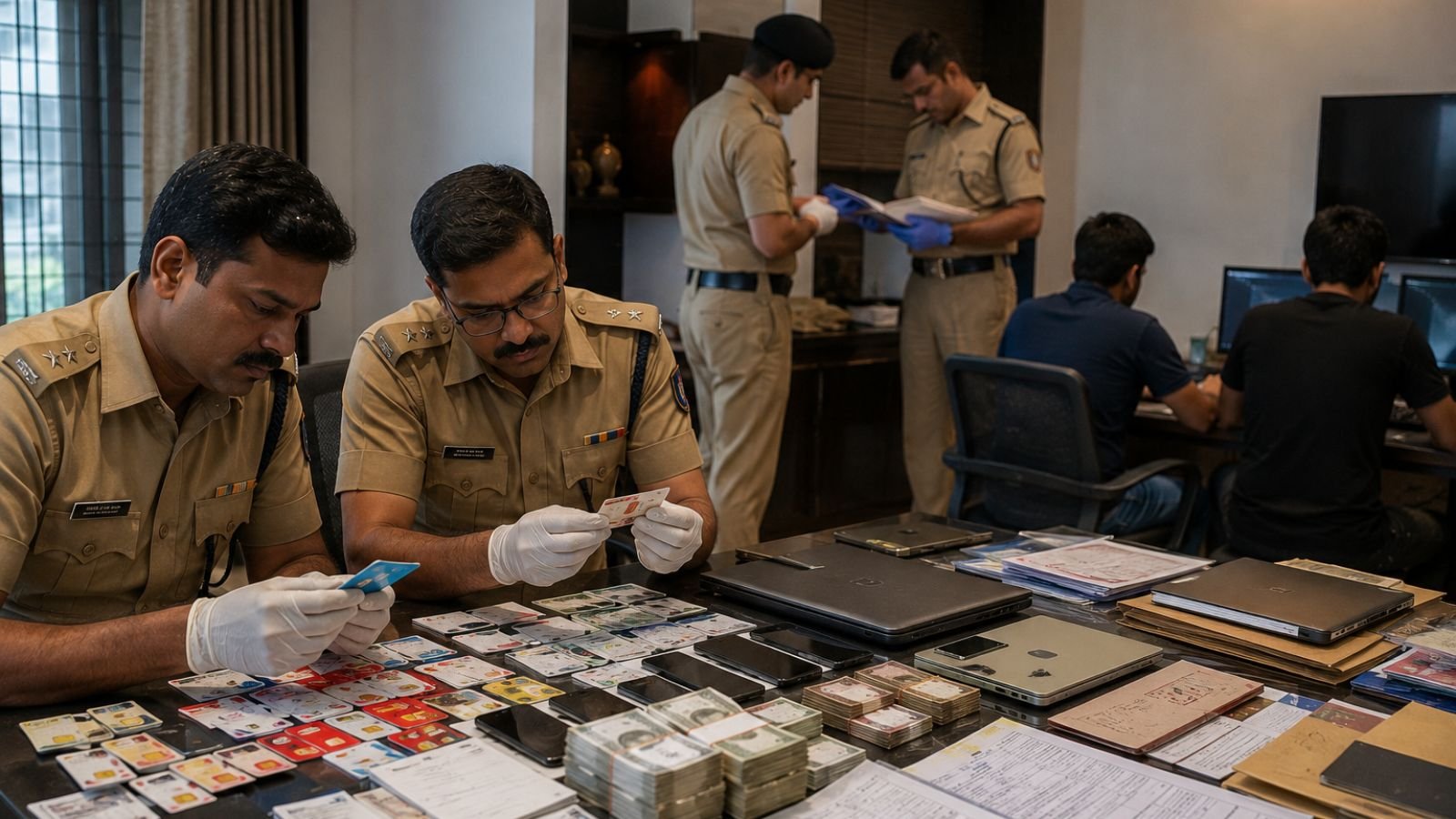
The Ahmedabad Crime Branch has significantly expanded its statewide crackdown on cybercrime-linked “mule accounts” under the ongoing Operation Mule Hunt and its latest enforcement phase, Operation Mule Hunt 2.0. According to the provided information, Gujarat Police are targeting a nationwide network involving rogue account handlers, institutional insiders, fraudulent SIM vendors, and organized cybercrime syndicates accused of routing and laundering illegally acquired money from online fraud operations. The latest investigations indicate that the crackdown has uncovered fraudulent financial trails worth more than ₹1,708 crore, making it one of the most aggressive anti-cybercrime financial investigations currently underway in India. Authorities claim that cybercriminals are increasingly using rented bank accounts, fake KYC profiles, illegally activated SIM cards, and layered cryptocurrency transactions to move stolen money.
What Is a Mule Account?
A mule account is a bank account used to receive, transfer, layer, or launder money acquired through cyber fraud or online scams. In many cases, cybercriminals recruit financially vulnerable individuals and offer them commissions in exchange for access to bank accounts, debit cards, passbooks, SIM cards, and UPI-linked accounts. Many victims are unaware that allowing others to use their banking credentials could lead to direct criminal liability under Indian law.
Operation Mule Hunt 2.0: Major Highlights
Financial Fraud Worth ₹1,708 Crore Under Scanner
Fraudulent financial trails exceeding ₹1,708 crore have been uncovered. Authorities reportedly intercepted multiple suspicious financial chains linked to cyber fraud activities across India. Thousands of offenses connected to mule accounts are being monitored under the operation.
Bank Managers and Personal Bankers Arrested
Investigators shifted focus toward institutional enablers during recent phases of the operation. Police reportedly arrested managers, personal bankers, and banking intermediaries. The arrests involved officials linked to Yes Bank, Axis Bank, and HDFC Bank. Allegations include bypassing KYC procedures, creating fake business documents, and opening mule accounts using fraudulent identities.
Interstate Gang Managing 197 Accounts Busted
An Anand-based interstate fraud network was dismantled. Authorities reportedly uncovered 197 linked bank accounts and fraud connections worth over ₹53 crore. One member of the network allegedly supplied a mule account to a suspect linked to the Baba Siddiqui murder case in Maharashtra.
SIM Card Vendors Under Strict Scrutiny
Several SIM card vendors allegedly misused applicant documents, activated unauthorized secondary SIM cards, enabled OTP interception systems, and helped control mule account operations remotely. Authorities believe these SIM cards played a key role in OTP authentication fraud, account takeover operations, and digital payment manipulation.
How Mule Account Syndicates Operate
Renting Financial Profiles
Cybercriminals target financially weak individuals and offer commission payments ranging between ₹3,000 to ₹15,000. In return, fraudsters gain access to ATM cards, UPI IDs, passbooks, mobile banking accounts, and banking credentials.
Multi-Layered Crime Infrastructure
- Layer 1: Local Recruiters: Identify and recruit account holders willing to “rent” their banking profiles.
- Layer 2: Logistics Handlers: Collect and ship debit cards, banking kits, and SIM cards. Some operations route materials to overseas hubs, including Dubai.
- Layer 3: Financial Laundering Teams: Layer transactions, move money through multiple banks, use cryptocurrency channels, and obscure the original source of fraud funds.
Major Cyber Scams Linked to Mule Accounts
- Digital arrest scams
- Deepfake-enabled Aadhaar frauds
- Fake investment schemes
- Online gaming portal frauds
Digital Arrest Scams Explained
Fraudsters impersonate police officials, government agencies, courts, or cyber officers. Victims are contacted through WhatsApp, Skype, or Zoom video calls. Scammers falsely claim the victim is under investigation, linked to money laundering, or connected to illegal activity. Victims are pressured into transferring money immediately to “clear” their name. Authorities clearly warn: no government agency conducts “digital arrests” through video calls.
Gujarat Cyber Tribunal Escalation
The Ahmedabad Crime Branch is escalating serious compliance failures directly to the Gujarat Cyber Tribunal. This applies in situations where banks fail transaction monitoring, digital platforms show negligence, or fraud alerts are ignored. Authorities are also using forensic financial tracking methods to identify frozen or recoverable funds.

How Citizens Can Protect Their Bank Accounts
1. Lock SIM Cards and Aadhaar Biometrics
Enable SIM PIN locks, protect OTP access, and lock Aadhaar biometrics using the mAadhaar app to prevent SIM swap attacks, unauthorized biometric withdrawals, and OTP theft.
2. Disable International Transactions
Disable international card usage, foreign transaction access, and international roaming banking permissions. Cybercriminal groups operating from overseas hubs often exploit globally enabled cards.
3. Never Rent Out Bank Accounts
Never share banking credentials for commission money, including passbooks, ATM cards, UPI accounts, or debit cards. Under Indian law, account holders may face prosecution if their account is used to move stolen money.
4. Set Daily Transaction Limits
Activate UPI limits, IMPS limits, and net banking transaction caps. Restricted limits can prevent fraudsters from emptying accounts in a single transaction sweep.
5. Verify “Digital Arrest” Claims
Police, courts, and government agencies never demand money through video calls. If such calls occur, disconnect immediately, do not transfer money, and report the incident instantly.
Golden Hour Rule: Why Immediate Reporting Matters
The “Golden Hour” refers to the first 1 to 2 hours after fraud occurs. Rapid reporting significantly improves the chances of freezing transactions, stopping fund withdrawals, and recovering stolen money.
Step-by-Step Process to Report Cyber Fraud
Step 1: Call 1930 Cyber Helpline
Dial 1930 to connect directly to the national cyber financial fraud response network. Officials can issue real-time freeze alerts to banks.
Step 2: File Online Cyber Complaint
Submit complaints through the National Cyber Crime Reporting Portal including transaction screenshots, UPI IDs, transaction IDs, account numbers, and chat records.
Step 3: Inform Your Bank Immediately
Contact the bank fraud helpline, visit the nearest branch, request account freeze, and submit dispute forms. Ask for a temporary freeze on outgoing transactions.
Step 4: Download Cyber Crime Acknowledgement Report
After complaint registration, download the Cyber Crime Acknowledgement PDF. This document may help with insurance claims, fund recovery, and official investigations.
Why Operation Mule Hunt 2.0 Matters
The investigation reflects the growing sophistication of cybercrime financial systems in India. Fraud networks now involve banking channels, telecom misuse, interstate financial chains, and organized laundering systems. The crackdown signals stricter monitoring of KYC compliance, SIM activation practices, and banking transaction surveillance. Authorities are increasingly focusing on the infrastructure supporting cybercrime rather than only the end-level fraud callers.
Conclusion
Ahmedabad Crime Branch’s Operation Mule Hunt 2.0 has emerged as a major nationwide crackdown against cybercrime mule account syndicates and digital fraud laundering operations. With investigations crossing ₹1,708 crore in suspected fraudulent trails, authorities are targeting the entire ecosystem behind cyber financial crimes, including account suppliers, telecom vendors, banking insiders, and layered laundering networks. The operation also highlights the increasing risk posed by digital arrest scams, fake investment schemes, deepfake-enabled Aadhaar frauds, and unauthorized SIM activation systems. For ordinary citizens, the investigation serves as a serious warning to never share banking credentials, rent bank accounts, or trust online impersonation calls demanding money transfers. Authorities stress that rapid reporting through the 1930 cyber helpline and the National Cyber Crime Reporting Portal remains the most effective defense during the critical “Golden Hour” after fraud occurs.
Frequently Asked Questions
Q1. What is a mule account?
A1. A mule account is a bank account used to receive, transfer, layer, or launder money acquired through cyber fraud or online scams.
Q2. What is the total fraudulent financial trail uncovered in Operation Mule Hunt 2.0?
A2. Authorities have uncovered fraudulent financial trails worth more than ₹1,708 crore.
Q3. Which bank officials have been arrested in the operation?
A3. Officials linked to Yes Bank, Axis Bank, and HDFC Bank have been arrested for bypassing KYC procedures and opening mule accounts using fraudulent identities.
Q4. What is the “Golden Hour” in cyber fraud reporting?
A4. The “Golden Hour” refers to the first 1 to 2 hours after fraud occurs, during which rapid reporting significantly improves chances of freezing transactions and recovering stolen money.
Q5. What is the cyber helpline number for reporting fraud?
A5. Victims should immediately call 1930, the national cyber financial fraud response helpline.