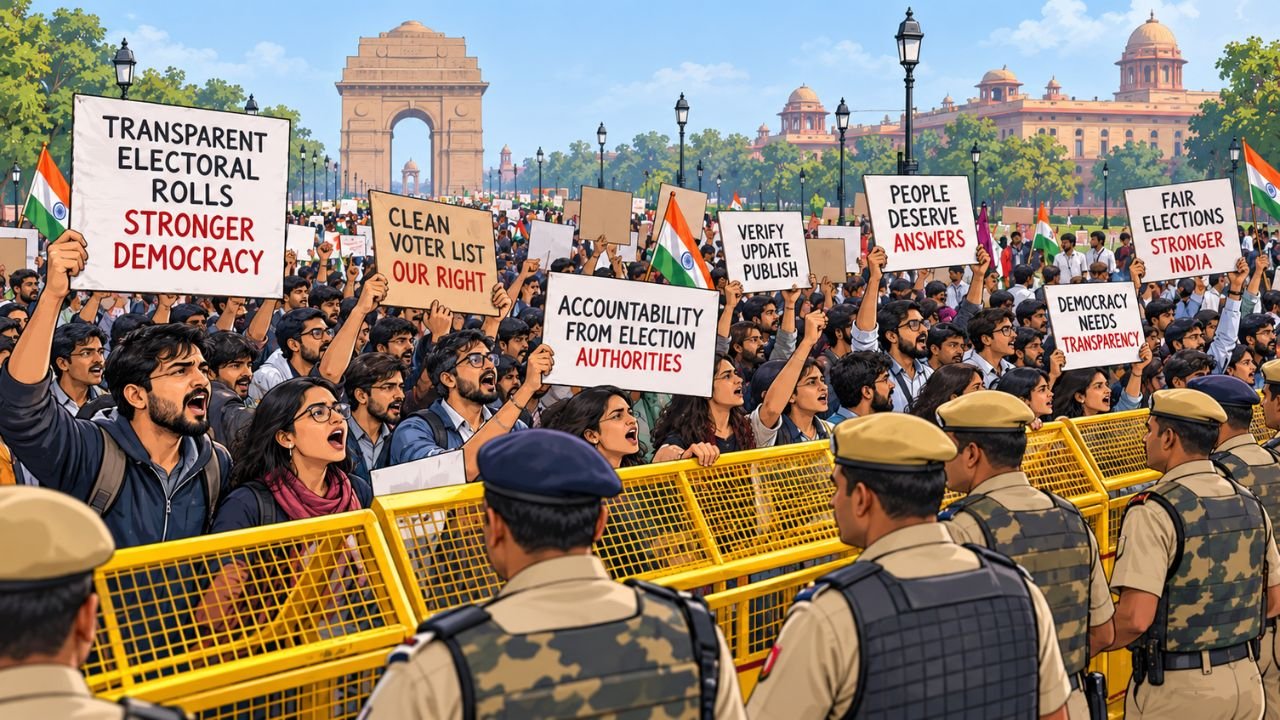
Massive youth-led demonstrations associated with the Gen Z movement known as the Cockroach Janta Party (CJP) have intensified across India, disrupting normal life in New Delhi and Mumbai. The protests peaked on October 2, 2026, with the central demand being the immediate resignation of Chief Election Commissioner (CEC) Gyanesh Kumar over allegations related to voter roll manipulation. The movement, which emerged earlier in 2026, has now shifted its focus strongly toward the Election Commission of India and the ongoing Special Intensive Revision (SIR) of electoral rolls. The protests have drawn support from opposition parties and triggered a political standoff that is expected to continue in the coming weeks.
What Is the Cockroach Janta Party?
The Cockroach Janta Party (CJP) emerged earlier in 2026 as an online satirical movement linked to youth frustration over unemployment and leaked examination papers. The group adopted its name after India’s Chief Justice reportedly referred to unemployed youth and online activists as “cockroaches.” The CJP is led by founder and convener Abhijeet Dipke and co-convener Saurav Das. The movement has built a large social media following and became an unexpected political force in July 2026. Its earlier mass demonstrations were connected with examination paper-leak issues and were described as having successfully forced Union Education Minister Dharmendra Pradhan to resign following a series of exam-leak scandals. This background shows how the CJP has grown from an online campaign into a movement capable of driving real political change.
The Core Dispute: SIR Voter Roll Revision
The current agitation focuses on the Election Commission of India (ECI) and its Special Intensive Revision of electoral rolls. The CJP and a broad coalition of opposition political parties have accused the ECI of carrying out a biased SIR process. They allege that the exercise removed a large number of legitimate voters from the system in a way that favored Prime Minister Narendra Modi’s ruling Bharatiya Janata Party (BJP). These allegations are at the centre of the protests and form the main reason behind the growing anger among youth groups and opposition leaders across the country.
Internal ECI Dispute
The protests also intensified following an investigative report by The Indian Express mentioned in the material. The report stated that fellow Election Commissioners Sukhbir Singh Sandhu and Vivek Joshi had formally objected at least 14 times over a 10-month period to unilateral decisions made by CEC Gyanesh Kumar regarding voter list updates. This report added to the concerns being raised by protesters over the voter roll revision process. The internal objections, as reported, gave further weight to the argument that the SIR process was being carried out without proper consultation or consensus within the Commission.
Three Main Demands of the CJP
The CJP has outlined three non-negotiable demands, which form the main focus of the current agitation. These demands have been repeated at every protest site and have become the rallying point for the movement.
- Immediate resignation of CEC Gyanesh Kumar
- Freezing of the controversial 2025 electoral roll
- Structural transparency reforms in the appointment of subsequent Chief Election Commissioners
These demands reflect the movement’s core concerns about the fairness of the voter revision process and the independence of the Election Commission.
October 2 Protests Cause Major Disruptions
The demonstrations on October 2 resulted in widespread disruptions and led to significant security measures by authorities. Both Delhi and Mumbai saw large-scale mobilisation, with police and administration taking different approaches to manage the crowds.
New Delhi Crackdown
In New Delhi, police denied permission for assemblies at Jantar Mantar and imposed Section 163 restrictions against unauthorized gatherings. More than 500 demonstrators were detained, including high-profile opposition political figures such as AAP leader Saurabh Bharadwaj, former Delhi Chief Minister Atishi, RJD leader Manoj Jha and activist Yogendra Yadav. Authorities also suspended mobile internet services within a 1.5-kilometre radius around Jantar Mantar and shut entry and exit access at 12 central metro stations, including Rajiv Chowk and Central Secretariat. The heavy security measures showed the scale of concern among authorities about the growing protest movement.
Mumbai Mobilisation
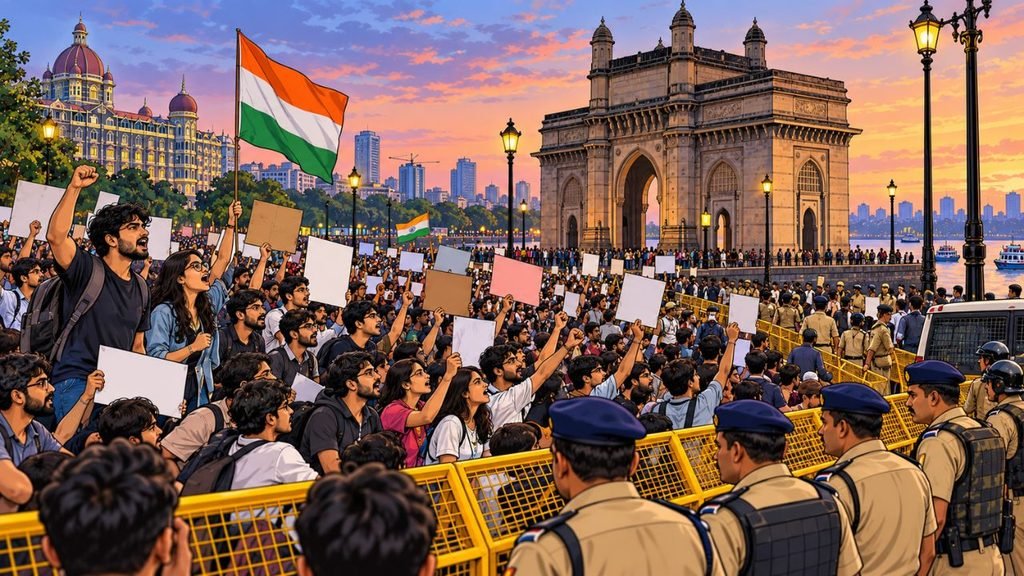
At the same time, thousands of CJP supporters gathered at Shivaji Park in Mumbai, despite police orders. The protesters carried signs demanding the resignation of Gyanesh Kumar. The agitation also received formal backing from regional opposition groups including Shiv Sena (UBT) and the Maharashtra Navnirman Sena (MNS). The Mumbai gathering demonstrated that the CJP’s message was resonating beyond Delhi and had found support across different states and political groups.
Election Commission’s Official Position
The Election Commission and the central government have denied allegations of voter fraud or manipulation. The ECI maintains that the voter revision exercise is intended to remove duplicate, deceased or ineligible records from the electoral system. It also maintains that no laws were violated. The Commission’s position therefore differs from the allegations being raised by the CJP and opposition groups. According to the ECI, the SIR process is a routine administrative exercise aimed at cleaning up voter lists rather than targeting any particular group of voters.
New Voters and Mistakenly Omitted Voters
On October 2, the Election Commission directed regional officials to immediately register newly eligible voters and reinstate individuals who had been mistakenly omitted. The move came as the protests and political pressure surrounding the voter roll revision intensified. CEC Gyanesh Kumar, according to the material, remained silent and did not directly address the resignation demands. The ECI’s directive to register new voters and reinstate omitted ones was seen by many as an attempt to address some of the concerns raised by protesters, though it did not satisfy the core demand for the CEC’s resignation.
Ruling NDA Criticises the Protests
The ruling National Democratic Alliance (NDA) criticised the protests. The NDA accused the CJP and opposition groups of weaponizing political anxiety to defend what it described as bogus voters. The contrasting positions have deepened the political dispute surrounding the voter roll revision, with protesters demanding changes and accountability while the ECI and ruling alliance defend the revision process. This back-and-forth has turned the SIR issue into a major political flashpoint ahead of upcoming elections.
What Is Planned Next?
The political standoff is expected to continue, with both opposition groups and the CJP announcing further demonstrations. The INDIA alliance, described as a unified opposition block of more than two dozen parties led by the Indian National Congress, has declared a “Save Democracy Week.” Opposition lawmakers plan coordinated nationwide protests on October 6, culminating in an alliance-led march directly to the ECI headquarters in New Delhi.
CJP Announces October 10 ‘Chalo Delhi’ March
The CJP has also announced another major mobilisation. CJP convener Abhijeet Dipke issued a public ultimatum stating that if Gyanesh Kumar does not step down, supporters from across India will march to Delhi and protest at Jantar Mantar on October 10. The youth movement plans to mobilise thousands of peaceful protesters from various states to converge on the national capital. The proposed October 10 demonstration is therefore set to become another major point in the ongoing dispute over the voter roll revision and the demand for the resignation of the Chief Election Commissioner.
Key Details of the CJP Protests
| Issue | Details |
|---|---|
| Movement | Cockroach Janta Party (CJP) |
| Leaders | Abhijeet Dipke and Saurav Das |
| Main Issue | Special Intensive Revision of electoral rolls |
| Main Demand | Resignation of CEC Gyanesh Kumar |
| Second Demand | Freeze the 2025 electoral roll |
| Third Demand | Transparency reforms in CEC appointments |
| Major Protest Date | October 2, 2026 |
| Major Cities | New Delhi and Mumbai |
| Delhi Location | Jantar Mantar |
| Mumbai Location | Shivaji Park |
| Further CJP Protest | October 10 |
| Planned Delhi Location | Jantar Mantar |
| Opposition Programme | “Save Democracy Week” |
| Planned Opposition Protest | October 6 |
What Citizens and Observers Need to Know
The CJP protests have become a major political event in India, with the SIR voter roll revision at the centre of the dispute. The movement has managed to bring together youth groups, opposition parties and civil society organisations under a common demand for accountability in the Election Commission. The October 2 protests showed that the movement has the ability to disrupt normal life in major cities, and the planned October 6 and October 10 demonstrations suggest that the pressure is unlikely to ease soon. For citizens and observers, the key points to watch are how the ECI responds to the allegations, whether CEC Gyanesh Kumar addresses the resignation demands, and how the ruling NDA and opposition parties position themselves as the political standoff continues.
Conclusion
The CJP protests have intensified around the Special Intensive Revision of electoral rolls and allegations of voter roll manipulation. The Cockroach Janta Party and opposition groups are demanding the resignation of CEC Gyanesh Kumar, a freeze on the 2025 electoral roll and greater transparency in the appointment of future Chief Election Commissioners. The Election Commission and central government have rejected allegations of voter fraud or manipulation and maintained that the revision process is intended to remove duplicate, deceased and ineligible records. Following the October 2 demonstrations in New Delhi and Mumbai, further protests are planned. The INDIA alliance has announced its “Save Democracy Week” programme and protests for October 6, while the CJP has announced a larger October 10 demonstration at Jantar Mantar in New Delhi.
Frequently Asked Questions
Q1. What is the CJP protest about?
A1. The CJP protests are centred on the Special Intensive Revision (SIR) of electoral rolls. The Cockroach Janta Party and opposition groups allege that the SIR process removed legitimate voters and demand the resignation of CEC Gyanesh Kumar.
Q2. What is the Cockroach Janta Party?
A2. The Cockroach Janta Party (CJP) is a Gen Z-led movement that emerged in 2026 as an online satirical campaign linked to youth frustration over unemployment and exam paper leaks. It is led by Abhijeet Dipke and Saurav Das.
Q3. What are the three main demands of the CJP?
A3. The CJP has three demands: immediate resignation of CEC Gyanesh Kumar, freezing of the 2025 electoral roll and structural transparency reforms in the appointment of future Chief Election Commissioners.
Q4. What happened during the October 2 protests?
A4. In New Delhi, police detained more than 500 demonstrators, suspended mobile internet around Jantar Mantar and shut access at 12 metro stations. In Mumbai, thousands gathered at Shivaji Park with signs demanding Gyanesh Kumar’s resignation.
Q5. What protests are planned next?
A5. The INDIA alliance has announced a “Save Democracy Week” with nationwide protests on October 6 and a march to the ECI headquarters. The CJP has announced a “Chalo Delhi” march on October 10 at Jantar Mantar if CEC Gyanesh Kumar does not resign.